What AEQI is
You describe what you are building in one sentence. By the end of the day you have a live website and a team of eleven AI agents already working on it: finding customers, writing emails, improving the site. You only step in to say yes.
A team, not a tool
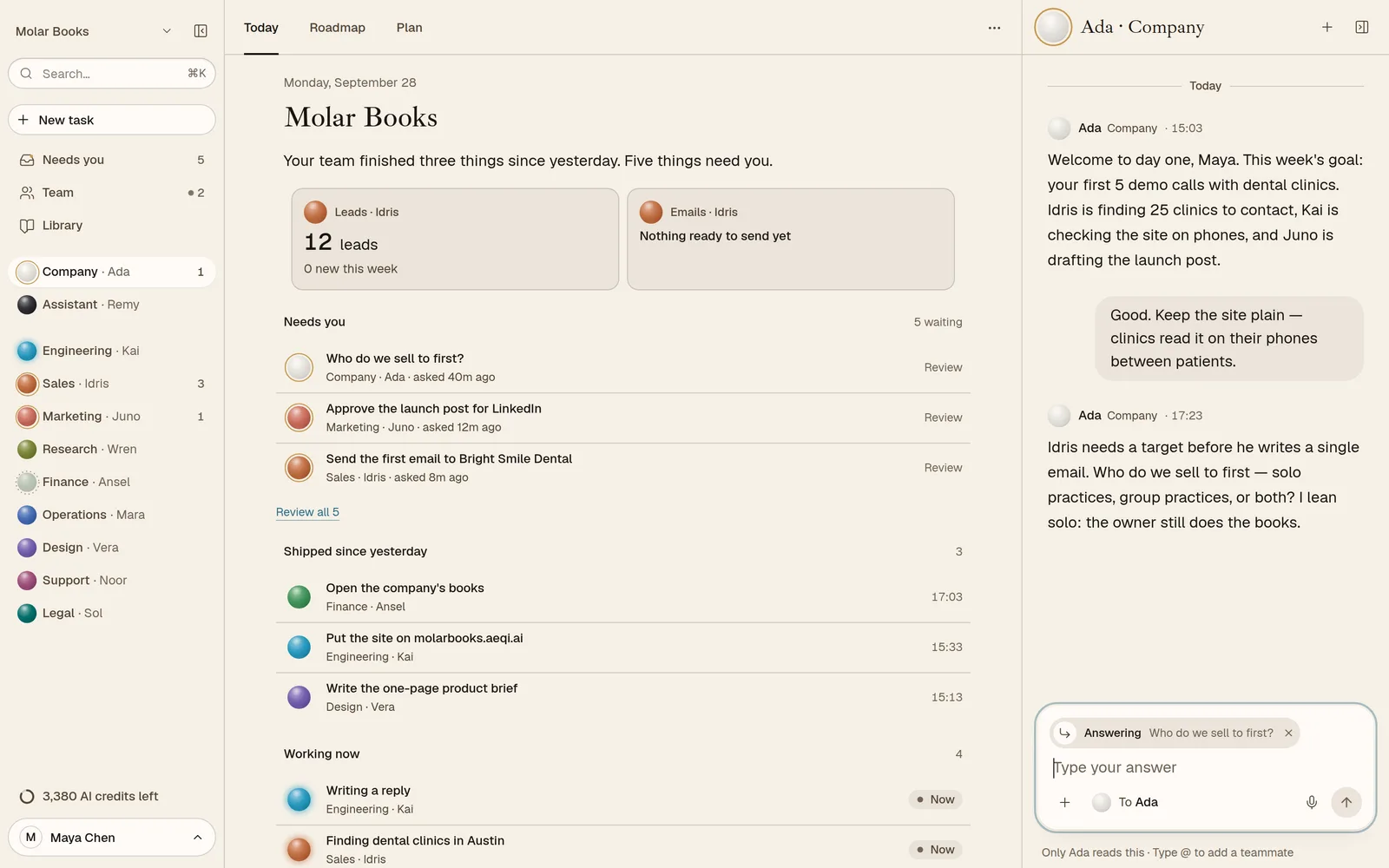
Most AI products are one assistant waiting for your next prompt. AEQI is a team of eleven, and each agent has one job: Engineering builds your website, Sales finds leads and writes the emails, Finance watches your money, Research watches your market, and so on. Ada leads them and runs the company day to day.
You don't have to manage eleven chats. Tell Ada what you want, and she hands the work to whoever owns it. Or talk to any agent directly, the way you would walk over to a colleague's desk.
What you get on day one
- A live website at yourname.aeqi.ai, written from what you told us.
- A team that is already working. In the first minutes every agent picks up its first piece of work: the site gets improved, the first leads get found, the first emails get drafted.
- One memory that holds what your company knows: who you sell to, what you decided, what worked.
- Its own computer. Your company runs on a server of its own in Europe, not in a shared pool.
You stay in charge
Your team works on its own, but nothing leaves your company without your OK. Every email to a real person, every change to your live website, every post waits in Needs you until you approve it, change it or say not now.
Who it is for
- Starting something new. Describe the idea in one sentence. You get a site today and a team that starts finding your first customers.
- Already running a business. Describe what you do. The team builds a site for it, finds leads and handles the busywork around your week.
You don't need to be technical. You write the way you would to a person, and your team shows you the work before anything goes out.
What AEQI is not
- It is not a chatbot you have to keep prompting. The team has routines and gets on with them.
- It does not act behind your back. Anything that reaches the outside world waits for you.
- It does not register a legal company for you. If you need one, form it where you live, whenever you are ready. Your team works the same either way.